By summer 2026, the number of documented deepfake cases worldwide had reached several million a year — an increase of about 900% in just two years. At the same time, a Microsoft study of 12,500 people, covering almost 287,000 ratings of images generated by DALL·E 3, Midjourney v6 and Stable Diffusion 3, found something sobering: people correctly recognize whether a photo was made by AI in only 62% of cases — barely better than a coin toss. For GAN-generated faces and photos edited with inpainting, recognition accuracy dropped below 50%, which is worse than random guessing.
This article is a complete, technical protocol for verifying digital content for AI — photos, video, audio and text. Instead of yet another list of “7 signs you can spot AI” (which, as the data above show, the human brain applies with roughly random accuracy anyway), I propose a methodology based on three independent layers of verification, backed by concrete tools, some of which are free and available to everyone.
Why “looking at the fingers” is no longer enough
Until recently, AI generators gave themselves away with telltale mistakes: an unnatural number of fingers, warped lettering, odd facial symmetry. In 2026, these signals have practically disappeared from the newest models — yet many guides still repeat the same outdated tips. Reliable industry sources admit it outright: “AI material no longer has six fingers or warped geometry” — you can still sense some intuitive “tell,” but without technical tools it’s increasingly hard to verify.
That’s why relying solely on visual analysis is now the weakest verification method available — not the strongest, as popular guides suggest.
The three-layer verification protocol
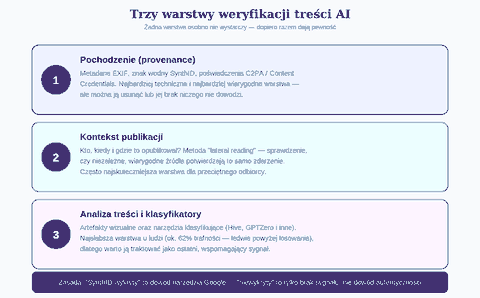
Professionals who verify content (OSINT, investigative journalism, cybersecurity) recommend checking three independent, mutually complementary layers of evidence. None of them gives certainty on its own — only by combining them can you draw a credible conclusion.
Layer 1: provenance
The first step is to check the file’s technical “pedigree” — metadata, watermarks and digital credentials.
EXIF metadata. Every photo from a camera or phone contains metadata by default: device model, date, lens settings. A file “straight from the camera” that bears traces of being exported from an AI generator needs explaining. Keep in mind, though: missing EXIF metadata isn’t proof of AI — most social networks routinely strip this data on upload, regardless of where the file came from.
SynthID. This is a digital watermarking mechanism developed by Google DeepMind. The watermark is embedded directly in the pixels of an image, video frames, the audio waveform or the structure of text generated with Google tools, and is designed to survive compression, cropping or resizing. Since its rollout in 2023, Google has marked more than 20 billion generated images with it. The key rule of interpretation: a detected SynthID is proof that the file came from a Google tool — but an undetected watermark is just the absence of a signal, never proof of authenticity (it may have been removed by heavy editing, or the file simply wasn’t created with a Google tool).
C2PA and Content Credentials. Coalition for Content Provenance and Authenticity (C2PA) is an open technical standard founded in February 2021 by Adobe, Arm, BBC, Intel, Microsoft and Truepic, now also backed by Google, OpenAI, Meta and Amazon — in January 2026 the standard had more than 6,000 member companies and affiliates. C2PA attaches a cryptographically signed “manifest” to the file containing its full history: who created it, with what tool, and what changes were made. Tampering with the file breaks the digital signature and is immediately detectable. The limitation is similar to SynthID: the standard certifies the file’s history, not its truthfulness, and it can be bypassed if the distribution platform strips metadata.
Layer 2: publication context
The second layer is checking who published the material, when and why — a method professional verifiers know as lateral reading . Instead of analyzing the file in isolation, you open a new tab and check whether independent, credible sources confirm the same event at the same time and place. If a supposed recording of an important event doesn’t appear in any reputable outlet and circulates only on one anonymous account — that’s a stronger warning sign than any pixel analysis. This layer relies on the same principles we described in more detail in our article on comparing different newsrooms’ coverage of the same event.
Layer 3: content analysis and automated classifiers
Only at the end — not at the beginning — is it worth turning to analysis of the content itself: telltale visual artifacts (inconsistent shadows and reflections, illogical background text, broken symmetry) and automated classification tools. As the Microsoft study showed, the human eye is unreliable in this layer, which is exactly where the specialized tools described later in the article add the most value.
Legal context: why this suddenly matters so much in 2026
On August 2, 2026, Article 50 of the EU Artificial Intelligence Act (AI Act) comes into force, imposing specific transparency obligations. Deepfakes — material that realistically depicts people, events or statements that never happened — must be labeled regardless of whether the creator intended to mislead anyone. Providers of generative AI systems must mark content in a machine-readable way (with a transition period until December 2, 2026 for tools already on the market), and entities publishing AI-generated content on matters of public interest must label it unless it has undergone genuine human editorial review. Penalties for non-compliance reach €15 million or 3% of a company’s global annual turnover — whichever is higher.
For the average internet user, this means that in the coming years more and more content will carry provenance labels readable by machines (though not necessarily by humans) — which makes knowing the tools that read these labels (described below) a practical skill, not just a technical curiosity.
Tools for verifying AI content — a practical overview
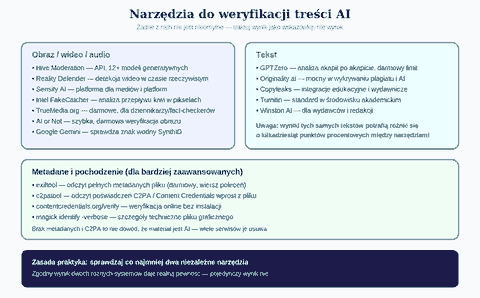
Below is a rundown of real, working tools, divided by content type. None of them is infallible — independent tests show discrepancies of several dozen percentage points between competing products, so the key rule is: check with at least two independent tools.
Tools for images, video and audio
- Hive Moderation — a content moderation API platform used by Reddit and Giphy, among others. It recognizes images generated by more than 12 different model architectures (Midjourney, DALL-E 3, Stable Diffusion, Flux) and can indicate which engine was probably used to create an image.
- Reality Defender — specializes in detecting deepfake video in real time; offers a browser extension for scanning websites and local files.
- Sensity AI — an enterprise-class platform for media and large online platforms, handling large volumes of content.
- Intel FakeCatcher — technically the most interesting solution: it analyzes the photoplethysmographic signal, i.e., subtle changes in skin color caused by blood flow, which synthetic faces don’t reproduce convincingly. Available mainly to institutional partners.
- TrueMedia.org — a free tool built with journalists and fact-checkers in mind.
- AI or Not — a fast, free tool for initial verification of a single image or audio recording.
- Google Gemini — the app lets you check for a SynthID watermark directly in an uploaded file.
Tools for text
- GPTZero — the most popular AI text detector, offering a free allowance (10,000 words a month) and paragraph-level analysis. In independent 2026 tests it showed high accuracy in detecting text generated by the newest models, although earlier independent tests recorded results much lower than the manufacturer claimed — discrepancies of several dozen percentage points between tests are the norm in this industry.
- Originality.ai — a popular tool combining plagiarism and AI content detection, stronger with older models than with the newest ones.
- Copyleaks and Turnitin — widely used in academia and publishing.
- Winston AI — aimed mainly at publishers and newsrooms verifying text originality.
Important caveat: the same texts, run through different detectors, can get wildly different scores — in some comparisons the discrepancy between tools for the same text exceeded 60 percentage points. None of these products should be treated as a final verdict, especially in high-stakes contexts (e.g., accusations of academic dishonesty).
Tools for reading metadata and provenance
- exiftool — a free command-line tool for reading a photo or video file’s full metadata.
- c2patool — the official tool for reading C2PA / Content Credentials directly from a file.
- contentcredentials.org/verify — a browser-based version of Content Credentials verification, no installation required.
- magick identify -verbose (ImageMagick) — a detailed technical analysis of an image file’s structure.
Why you shouldn’t trust any tool uncritically
The AI detector market is growing by several dozen percent a year, and so is the spread in quality. Independent 2026 tests show that the accuracy manufacturers claim (often 95–99%) can be significantly lower in practical, independent testing, and false-positive rates (wrongly flagging human work as AI) usually range from 5 to 12%, depending on the tool and content type. That means even a good tool can wrongly accuse authentic material — so the result of a single detector should never be the only basis for serious decisions (e.g., rejecting a student’s paper or accusing someone of publishing a fake).
The safest practice: treat every tool as one voice in a larger evidence-gathering process, combine content analysis with the provenance and context layers, and always look for agreement between at least two independent sources of verification.
A practical step-by-step protocol
- Secure the original. Before you start your analysis, save the file in its original quality — screenshots or compressed copies lose metadata and make further verification harder.
- Check the metadata and C2PA with a tool such as exiftool or c2patool / contentcredentials.org.
- Check for a watermark if you suspect Google tools — via the Gemini app.
- Apply lateral reading — check whether independent, credible sources confirm the same material or event.
- Run at least two independent classifiers (e.g., one for images, one for text, or two competing tools of the same type) and compare the results.
- Draw a conclusion proportional to the evidence. Agreement across all three layers gives high confidence; contradictory or ambiguous signals justify only a cautious conclusion, not a categorical claim.
Frequently asked questions
Is there one tool that can recognize every kind of AI content?
No. Detecting images, video, audio and text are separate technical problems, solved with different methods. Even large platforms like Hive or Reality Defender combine many specialized models under one interface rather than relying on a single universal algorithm.
Does the absence of an AI Act label mean the material definitely isn’t AI-generated?
No. The labeling obligation comes into force gradually (from August and December 2026) and applies mainly to providers and entities operating in the EU — creators outside the EU or those breaking the law won’t always comply.
Should you trust the 99% result a detector gives you?
Treat the accuracy claimed by the manufacturer with limited trust — independent tests regularly show results that differ significantly from marketing materials. What matters most is agreement with results from other, independent sources of verification.
Summary
Detecting AI-generated content in 2026 is no longer a matter of a trained eye, but of a systematic process based on three complementary layers: the file’s technical provenance (metadata, SynthID, C2PA), the publication context (lateral reading) and — only at the end — content analysis supported by specialized tools. No single method, including any commercial detector, gives one hundred percent certainty. The upcoming rules of the EU AI Act will change the landscape of content labeling, but responsibility for critically verifying what we see online will remain — as before — with the audience.