In the first quarter of 2026, the APWG (Anti-Phishing Working Group) recorded 971,181 reported phishing attacks — 13.8% more than the previous quarter. The telecom industry was hit hardest: the share of attacks targeting the sector jumped from 5.9% to 33% in a single quarter. Behind each of these numbers there’s usually the same ridiculously simple mechanism — someone clicked a link without reading the address it actually led to.
The good news is that reading a URL is a skill you can learn in a quarter of an hour — and it works no matter how clever a message a particular scammer has crafted. In this article we show what a web address really consists of, why you need to read it from right to left rather than the way you read an ordinary sentence, and what the most popular tricks look like in practice — with concrete examples. (We use a fictional Polish bank, “mojbank.pl” — literally “mybank” — and a few well-known Polish brands as examples.)
Anatomy of a URL — what it’s really made of
Before we get to scammers’ tricks, it’s worth breaking a URL down into its parts. Let’s take one completely fictional example that will serve us throughout the article:
https://konto.mojbank.pl/logowanie?sesja=8271
The same address, broken into parts, looks like the animation below — each fragment lights up in turn:
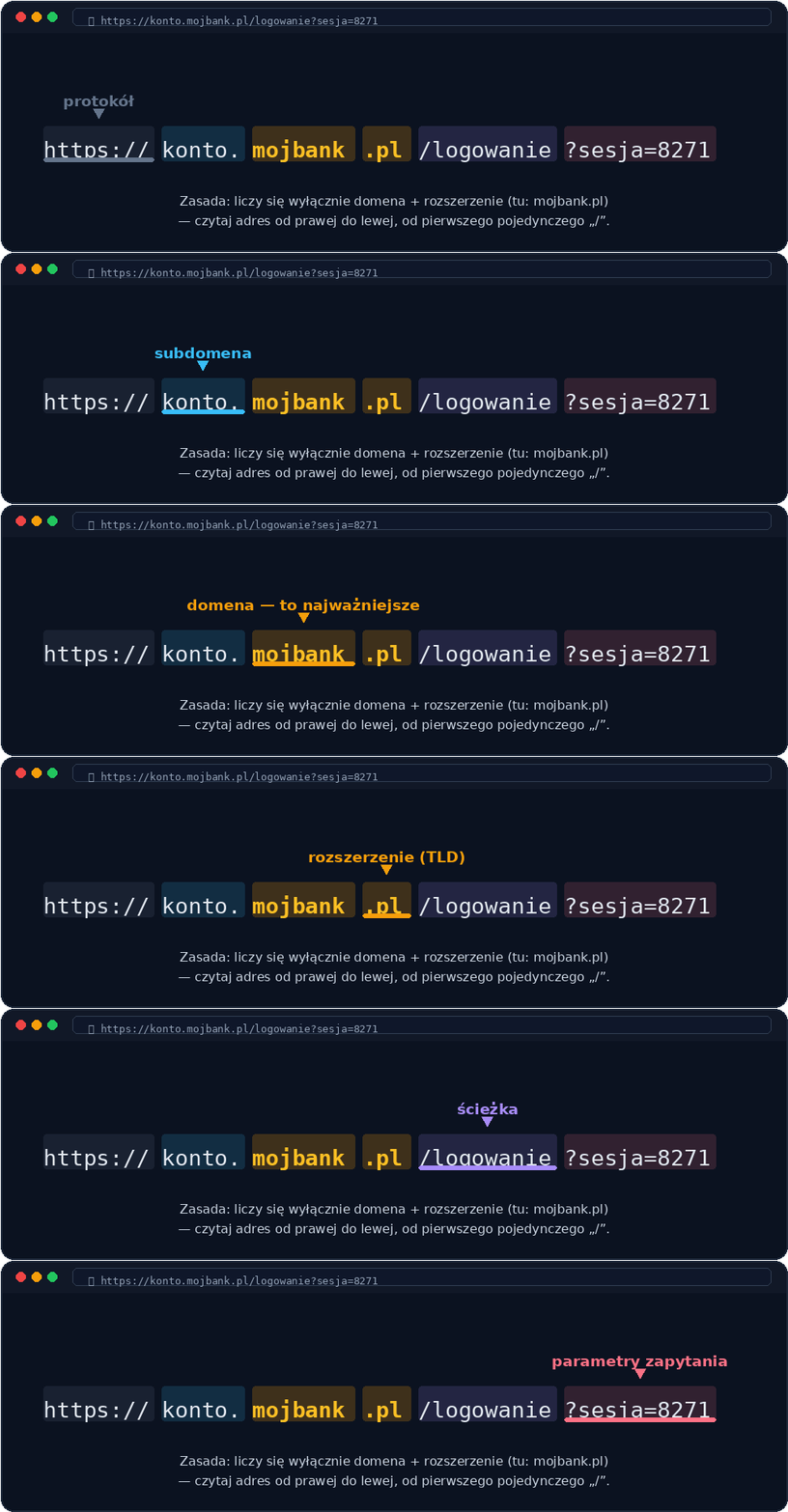
A short explanation of each part:
- Protocol (scheme) —
https://. Tells the browser which “language” to use to connect to the server. The letter “s” means an encrypted connection — but, as we’ll show later, that’s not the same as a “safe site.” - Subdomain — in our example
konto.. This is a label the owner of the main domain can set however they like, for free, in unlimited numbers (poczta.mojbank.pl, konto.mojbank.pl, blog.mojbank.pl — the owner of mojbank.pl can create all of these in five minutes, without any additional registration). - Domain and extension (TLD) —
mojbank.pl. This is the only part of the address that really tells you who owns the site. It’s registered and paid for with a domain registrar — unlike a subdomain, it can’t be “added” without formal registration. - Path —
/logowanie. A specific subpage within the site. It can sound completely credible even on a fake domain — the attacker decides what to name the folder on their own server. - Query parameters —
?sesja=8271. Data sent to the server, visible after the question mark. They say nothing about the site’s credibility.
The most important rule: read the address from right to left
This is the most important sentence in the whole article: unlike ordinary text, a domain has to be read from right to left. Find the first single “/” in the address (the one that starts the path), then go back left to the nearest dot. What lies between those two points is the only part of the address the site’s owner actually registered and paid for. Everything to the left of it — including any number of “subdomains” — can be set freely, without any registration, by anyone who owns any domain in the world.
That’s exactly why phishers’ most dangerous trick works: placing a well-known brand as a subdomain of someone else’s domain. The address mojbank.pl.bezpieczna-weryfikacja.ru contains the text “mojbank.pl” — but it’s just a label freely assigned by the owner of a completely different domain: bezpieczna-weryfikacja.ru. See it in a few examples:
| The address you see | The real domain (read from the right) | Verdict |
|---|---|---|
konto.mojbank.pl/logowanie |
mojbank.pl |
Genuine — a legitimate subdomain |
mojbank.pl.bezpieczna-weryfikacja.ru/logowanie |
bezpieczna-weryfikacja.ru |
Fake — “mojbank.pl” is just a subdomain label |
www.allegro.pl/moje-zakupy |
allegro.pl |
Genuine |
allegro.pl-platnosci-bezpieczne.com/oplata |
pl-platnosci-bezpieczne.com |
Fake |
inpost.pl.sledzenie-paczek.info/status |
sledzenie-paczek.info |
Fake |
Ten tricks scammers use to disguise fake addresses
- A typo / swapped letters —
mojbnak.plinstead ofmojbank.pl. When we’re in a hurry, our brain automatically “corrects” typos, so we rarely notice them. - A missing character —
mojbnk.plinstead ofmojbank.pl. - An extra character —
mojbankk.plinstead ofmojbank.pl. - A similar letter or digit — the digit
0instead of the letter “o,” the digit1instead of “l”:m0jbank.pl,a11egro.pl. - A hyphen instead of a dot —
moj-bank.plis a completely different, unrelated domain, not a “spelling variant” of mojbank.pl. - The wrong extension (TLD) —
mojbank.comorallegro.coinstead ofallegro.pl. Someone completely different can register the same name under a different extension. - The real name as a subdomain of someone else’s domain — the most dangerous of these tricks, described above:
mojbank.pl.bezpieczna-weryfikacja.ru. The address “contains” a familiar name, but the real domain is what comes directly before the first single “/”. - Homographs and punycode — a domain made of letters from another alphabet that are visually indistinguishable from Latin ones. In 2017, security researcher Xudong Zheng registered the domain
xn--80ak6aa92e.com, which Chrome, Firefox and Opera displayed as plainapple.com— because every letter came from the Cyrillic alphabet but looked identical to its Latin counterpart. Browsers handle this very differently: a 2021 USENIX study found that Safari detected 90.3% of such domains, Firefox only 6.1%. - The @ sign in an address — in a link like
https://mojbank.pl@zle-serwery.ru/logowanieeverything before the@sign is ignored by the browser. The real host address is what comes after the@, i.e.zle-serwery.ru. It’s an old trick, but it still works best where you can’t see the address bar before clicking — e.g., in text messages. - An IP address instead of a domain —
http://185.23.44.12/logowanie. No serious bank or major service asks you to enter a password at a bare IP address.
On top of that there are shortened links (bit.ly, tinyurl.com and similar), which by definition hide the destination domain until you click. They’re not dangerous in themselves — legitimate companies and media use them too — but if they come from an unknown source it’s worth expanding them first with a preview tool rather than clicking blindly.
Isn’t the padlock (HTTPS) enough?
Many of us were taught a simple rule: “look for the padlock in the address bar — it means the site is safe.” That advice made sense a decade or so ago — today it’s dangerously incomplete.
The padlock and the https:// prefix mean only that the connection between your browser and the server is encrypted — nobody “along the way” can see the data being sent. They say absolutely nothing about who is on the other side of that connection. An encryption certificate — for example from the free, completely legitimate organization Let’s Encrypt — can be set up in minutes by anyone, including someone who has just registered the domain mojbank.pl.bezpieczna-weryfikacja.ru. Modern phishing sites almost always have an active padlock, because browsers warn about missing encryption anyway — so attackers simply set it up.
Takeaway: the padlock signals encrypted transmission, not a trustworthy sender. The only thing that counts is the domain, checked using the “right to left” rule described above.
A practical protocol: 6 steps before you click
- Don’t click on reflex. Time pressure (“Your account will be blocked within 24 hours”) is the most popular phishing technique — in itself it should make you suspicious.
- On a computer, hover over the link (without clicking) and look at the status bar in the bottom-left corner of the browser — the real destination address will appear there.
- On a phone, press and hold the link (long press) — a preview of the full address will appear before you open it.
- Find the domain by reading from the first single “/” to the left, up to the nearest dot. What you see there is the only reliable indication of who owns the site — the rest of the address can be anything.
- Expand shortened links before clicking if they come from an unknown source — e.g., via a site like checkshorturl.com.
- When in doubt, don’t click at all. Go to the site manually by typing an address you know into the browser or using your own bookmark.
Frequently asked questions
Does a green padlock in the browser mean the site is safe?
No. The padlock only tells you the connection is encrypted. It doesn’t confirm the identity of the site’s owner — anyone can set up an encryption certificate, including the creator of a fake domain.
Does a subdomain always mean fraud?
No — subdomains are a normal, legitimate mechanism used by real companies (e.g. poczta.google.com, konto.mojbank.pl). The problem is the opposite situation: when a name you know (e.g., “mojbank.pl”) appears as a subdomain of a completely unrelated, unknown domain.
Are short links (bit.ly, tinyurl) always dangerous?
Not in themselves — legitimate companies and media use them too. The problem is that they hide the destination domain until you click, so it’s worth expanding a link from an unknown sender first.
How can I check who really owns a domain?
You can check a domain’s registration data with a WHOIS lookup (e.g., at whois.com). Among other things, you’ll see the registration date — a domain created a few days ago that impersonates a large, well-known service is a serious warning sign.
Can I check all this on a phone, where the address bar isn’t visible?
Yes — in most mobile apps and browsers you just press and hold a link (long press) to see a preview of the full address before you open it.
Summary
A URL looks like a string of random characters, but it has a strict, predictable structure — and the only part that really identifies the site’s owner is the domain and its extension, read from the first single “/” to the left, up to the nearest dot. Everything else — the subdomain, the path, the parameters, even the HTTPS padlock — can be set however someone likes, including by a scammer. Tens of thousands of phishing attacks reported every quarter rely precisely on the fact that most of us read an address from left to right and trust the first familiar fragment. Reversing that habit — looking at the address from right to left before you click — is one of the simplest and at the same time most effective digital self-defense skills.
Want to deepen this knowledge?
Reading URLs is one of many skills described in our “How to Search?” guide — a practical PDF guide that teaches you step by step how to search for, check and verify information online and in conversations with artificial intelligence. Get the guide — a one-time payment, lifetime access.
We develop AI Blog as a community project, with no ads and no sponsors. If you found this article useful, you can support us on Buy Me a Coffee — every dollar genuinely turns into more guides and educational materials.
Also subscribe to our YouTube channel, where we show in an accessible way how to recognize fake sites, disinformation and AI-generated content.